


ORDERS ARE NOW CLOSED
〰️
ORDERS ARE NOW CLOSED 〰️
ORDERS CLOSED
We have reached our target of 50 property owners who have taken advantage of our ‘weed for plant exchange’. We are not taking any more orders, but there are still a few dozen assorted plants available for anyone who was unable to send in an order, and is able to come to the pick-up on Saturday 6 June. Maximum of 5 plants.
Narkabundah Nursery will be open for collection of plants at 10 am until 2 pm. When collecting your plants firstly register with us and nominate the main weed (s) that you have been targeting on your property, verge or in the Coastal Reserve.
You can also purchase other plants from the nursery.
The Sandy Point Community Group, through its Habitat initiative, has developed a 'Weed for Plant Exchange' project which aims to reduce/remove invasive trees and plants and replace them with indigenous plants suitable for Sandy Point gardens. Plants such as Agapanthus, Gazania, Blue Periwinkle, English Ivy, Mirror Bush and Pittosporum readily invade nature strips and coastal reserves reducing plant biodiversity and impacting local fauna by changing habitat and food sources.
The Grant will enable/encourage town residents to remove these plants and replace them with suitable indigenous plants. These local indigenous plants thrive in sandy soil and will tolerate varying degrees of salinity and provide food and habitat for our local fauna.
This opportunity is open to private property owners and to community members and groups who are keen to target areas like their own block, beach access tracks or areas around the town including the Surf Club.
Link to ‘Environmental Weeds’ and ‘Local Plants for Local Gardens’ tip sheets
Program Outline
In 2025, Planet Ark provided funding ($1760) to Narkabundah Wildflower Nursery to propagate 800 plants and to provide some plant guards.
100 Manna gum tube stock were given to community members to plant on their Sandy Point properties to increase the food and shelter source for our local koala population.
WiSP habitat group has removed weeds on two street corner sites in the township and will revegetate with local grasses and shrubs. These two areas will showcase to the community what can be done on their own properties.
Community members will be given an opportunity to ‘exchange’ some weeds from their property with some of the indigenous plants available. See Activity 4 in Upcoming activities for how to participate. You can start now!
-
Activity 3 - Planting Day
The WiSP Habitat group will plant indigenous tube stock at the two corner sites which were weeded in March.
Corner of Park Ave & Beach Pde - Thursday 21 May, 9:30am
Corner Ennisvale Ave & Graeme Gve -Saturday 30 May, 9:30am
Activity 4 - Weed / Plant Swap
Process: Property owners/community members can register their interest in doing a ‘weed – plant swap’, via email. Print and use the plant request form.
While some evidence of weed removal is desirable it will be an honesty system. Weedy plants can be placed in your own green waste bins as these are then taken to the Pinegro facility in Morwell where they are processed into garden products. Lists of weeds commonly found in Sandy Point can be accessed here.
Plants: Each participant will be given a list of preferred plants and can request a maximum of 10 tube stock plants per property.
Email: [email protected]
Note: Project coordinators will endeavour to provide preferred plants upon request, but cannot guarantee availability due to demand.
Collection Day: Saturday 6 June. 10am - 2pm at Narkabundah Nursery
-
Activity 1 - Corner of Park Avenue and Beach Parade.
A ute load of gazanias was removed from this site by 8 hard-working volunteers from the WiSP Habitat Group. The site will be mulched and replanted in May.
Activity 2 - Corner of Graeme Grove and Ennisvale Avenue.
Volunteers from the WiSP Habitat Group removed 6 ute/trailer loads of agapanthus from this site. Thanks go to Rob for firstly digging most of the plants up with his machinery and then for helping us dispose of them. Also many thanks to our 12 volunteers - a hard job, well done. This site will be mulched and replanted in May.
Plants that are available for exchange are listed on the request form.
Select local indigenous plants for your garden
This is a guide to local (indigenous) plants that are suitable for Sandy Point gardens. These plants can thrive in sandy soil and will tolerate varying degrees of salinity and wind. They can help increase the biodiversity of the village and provide food and habitat for local fauna.
-
Scrub or Swamp Sheoak
Allocasuarina paludosa
Compact habit < 2m. Screening plant. Bird attracting. Soft foliage suitable for brushing up against in narrow walkways/driveways.Sea Box
Alyxia buxifolia
Slow growing. Attractive dark green small leaves.Suitable for hedging and clipping into spheres. White windmill-like small flowers Oct to Feb.Coast Saltbush
Atriplex cinerea
Silver-grey foliage. Spreading habit < 2m Salt and drought tolerant.White Correa
Correa alba
Spreading low shrub <1.5 m with tiny white star-shaped flowers. Suitable for hedging and shaping/ tip pruning which encourages flowering. Year round habitat and food for birds.Silky Guinea-flower
Hibbertia sericea
Small upright yellow flowered shrub with small dark green leaves. Prune after flowering to shape shrub and encourage growth.White Kunzea
Kunzea ambigua
Shrub growing 1-3 m has white honey- scented flowers. Suitable for hedgingCoast Daisy-bush
Olearia axillaris
Greyish shrub with dense branches and tiny yellow flowers. Suitable for hedging. Good soil binder.Sticky Daisy-bush
Olearia glutinosa
Shrub < 2 m has attractive blue-green sticky foliage and attractive white to mauve flowers in summerSnowy Daisy-bush
Olearia lirata
Masses of white flowers in spring. Prune after flowering. Shrub usually grows up to 3 m locally.Dusty Daisy-bush
Olearia phlogopappa
Shrub < 2 m with many white flowers. Prune after flowering.Coast Everlasting
Ozothamnus turbinatus
Dense upright shrub with stiff narrow leaves and stems. It flowers in autumn with cream to yellow flower heads. Can be hard pruned after floweringBassian Pomaderris
Pomaderris oraria
Shrub with dull crinkly leaves. Suitable for hedging. Not usually eaten by rabbits if unguarded.Coast Pomaderris
Pomaderris paniculosa
Shrub with green glossy leaves. Suitable for hedging. Has cream to greenish flowers in Spring.Seaberry Saltbush
Rhagodia candolleana
Fast growing spreading shrub. Useful ground cover on exposed steep slopes.White Elderberry
Sambucas gaudichaudiana
Attractive green leaves with bright white fragrant flowers between Oct and Feb. An annual plant that does well in a moist shady position.Kangaroo Apple
Solanum aviculare
Fast growing shrub 1-4 m in height with attractive dark green leaves and violet flowers Sep-Feb followed by orange to scarlet ovoid fruit. Prune heavily to rejuvenate. -
Drooping or Coast Sheoak
Allocasuarina verticillata
Can grow quite large and it may be difficult to establish other plants under its canopyCoast Banksia
Banksia integrifolia
Slow growing but potentially large tree. Can be pruned. Has yellow flower spikes much of the year. Bird attracting.Silver Banksia
Banksia marginata
Local form. Up to 2m. Useful for screening. Has yellow flowers in autumn.Sweet Bursaria
Bursaria spinosa
Creamy scented flowers at Christmas, and branches spiny when young. Can be pruned.Coast Manna Gum
Eucalyptus viminalis ssp pryoriana
Can be pruned if growing too large. Is koala fodder food. Protect from koalas when young. Tree canopy spreads often with a dense crown. It has an attractive rough bark. Food source for birds and butterflies.Coast Tea-tree
Gaudium laevigatum (Leptospermum laevigatum)
In smaller spaces can be pruned to limit growth. Often self germinates in bush blocks. Stunning spring display of small white flowers.Coast Beard Heath
Leucopogon parviflorus
Often self germinates in bush blocks. Slow growing large shrub with crowded tiny white flowers in spring.Common Boobialla
Myoporum insulare
Can grow into large tree but can be pruned easily. Fast growing. Fragrant white flowers with purple spots Sep-Dec. Can be used for screening or as a windbreak. -
Coast Spear-grass
Austrostipa flavescens
Perennial grass that grows as tufts to 1.2 m high. Useful soil binder in front-line coastal planting.Coast Spear-grass, Prickly Spear-grass
Austrostipa stipoides
Grows into attractive tussock, but leaf ends are very prickly.Black-anther Flax-lily
Dianella revoluta
Gradually spreads to form dense clumps sometimes covering large areas. It has attractive blue to violet flowers between Oct and Jan followed by bright round violet-purple berries.Knobby Club-sedge
Ficinia nodosa
Good soil binder. Has attractive globular flower heads changing in colour from yellow-green to brown.Chaffy Saw-sedge
Gahnia filum
Perennial leafy tussock. 0.6 - 1.2 m high. Prefers saline or brackish moist conditions and full sun. Attractive flowers and also butterfly food.Red-fruited Saw-sedge
Gahnia sieberina
Can grow into a tall and wide tussock with attractive yellow-brown flowers and then bright shiny red nuts. It likes moist conditions. It is a food plant for butterflies.Coast Saw-sedge
Gahnia trifida
Upright clumping sedge with narrow in-rolled leaves and pale to dark brown flowers.Sea Rush
Juncus kraussi
Prefers saline moist conditions so not suited to all local garden environments. It has attractive reddish-brown flowers Dec to Mar.Coast Sword-sedge
Lepidosperma gladiatum
A spreading sedge that grows well under partial shade.Spiny-headed Mat-rush
Lomandra longifolia
A tussock-like rush that grows well in the shade. Grows to 1 m in height and has atractive male and female flowers.Weeping Grass
Microlaena stipoides
Suitable for lawns in shade. A perennial grass with graceful arching stems. It can be mowed in a lawn but may invade into garden beds.Coast Tussock-grass, Blue Tussock-grass
Poa poiformis, var. poiformis
A locally common tussock-grass that prefers coastal conditions.Kangaroo Grass
Themeda triandra
Blue-green tussock with attractive dried flower heads. Self seeds in local conditions. -
Small-leaved Clematis
Clematis microphylla
Often self germinates in bush blocks. Will climb and spread through nearby trees or structures.Love Creeper
Comesperma voluble
Climber that can form dense tangles on supporting bush but won’t cover large areas. Occurs naturally in Sandy Point but is difficult to establish in gardens.Twining glycine
Glycine clandestina
Open twining plant. Has pretty tiny mauve pea flowers in spring.Austral Trefoil
Lotus australis
Grown from seed soaked in hot water overnight. Height to 60 cm and ground creeping. White to pink flowers mostly in spring.Climbing lignum
Meuhlenbeckia australis
Can form mounds on the ground or dense tangles in other shrubs to provide habitat for small birds. -
Austal bugle
Ajuga australis
Small border type plant with blue flowers of various shades. Its foliage is attractive when not flowering.Karkalla
Carpobrotus rossii
Spreads easily in a sunny position. Often better if planted in a confined area.Kidney Weed
Dichondra repens
Spreads easily once established. May dry off in hot weather. Likes damp shady places.Running Postman
Kennedia prostrata
May need protection from slugs and rabbits when young. Red flowers in springAustral Stork’s-bill
Pelargonium australe
Grows easily from seed. Pink flowers. Drought tolerant.Ivy-leaf Violet
Viola hederacea
Spreads easily once established. May dry off in hot weather. Likes damp shady places.Satin Everlasting
Helichrysum leucopsideum
Upright perennial herb growing to 50 cm in height. Yellow flowerheads with white bracts October to March. Can be pruned back in winter to encourage new growth. Butterfly attracting.Common Everlasting / Yellow Buttons
Chrysocephalum apiculatum
Low growing to 30 cm in height and spreading to > 1 m. Silver grey foliage with yellow flowers possible much of the year particularly in Spring.
Read more …
Schremmer, J. (2026, April 16). Why experts urge not to grow these popular invasive plants in your home. ABC News. https://www.abc.net.au/news/2026-04-17/invasive-plants-in-australian-homes-damaging-gardens-environment/106492040
Print bi-fold brochure : ‘Plant for Weed’ exchange

'Plant for Weed' exchange. Side 1
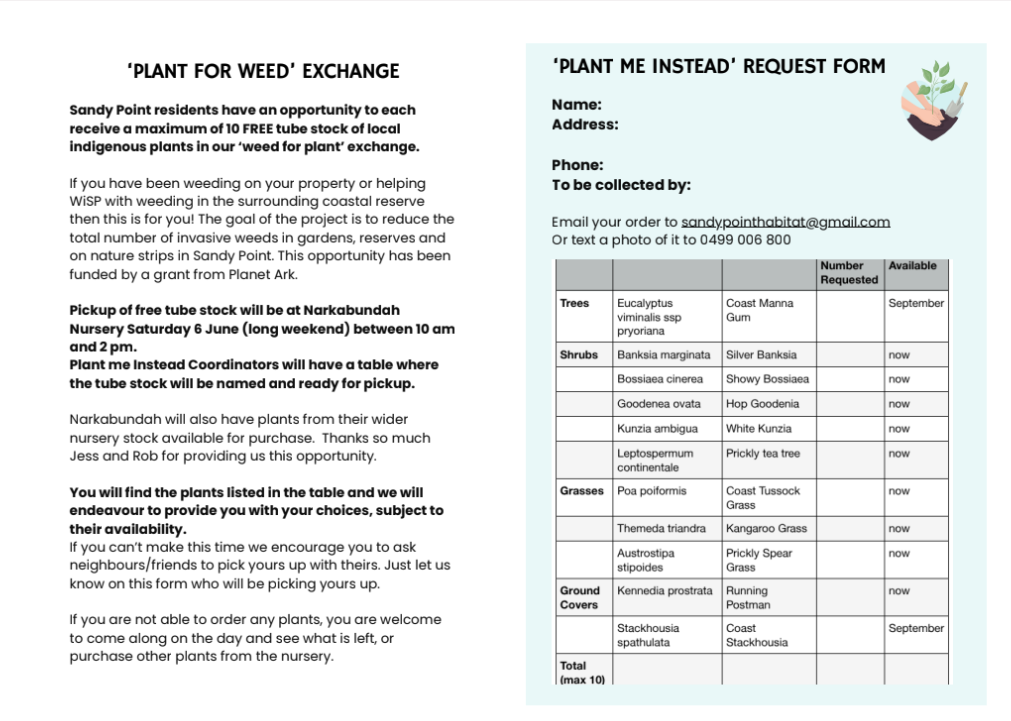
'Plant for Weed' exchange. Side 2
Sandy Point Community Group: Local Plants Guide
Home | All Plants | Trees | Shrubs | Scramblers & Climbers | Grasses, Rushes & Sedges | Herbs | Lilies & Orchids | Ferns | Weeds
Print bi-fold brochure : ‘Local Plants for Local Gardens in Sandy Point’
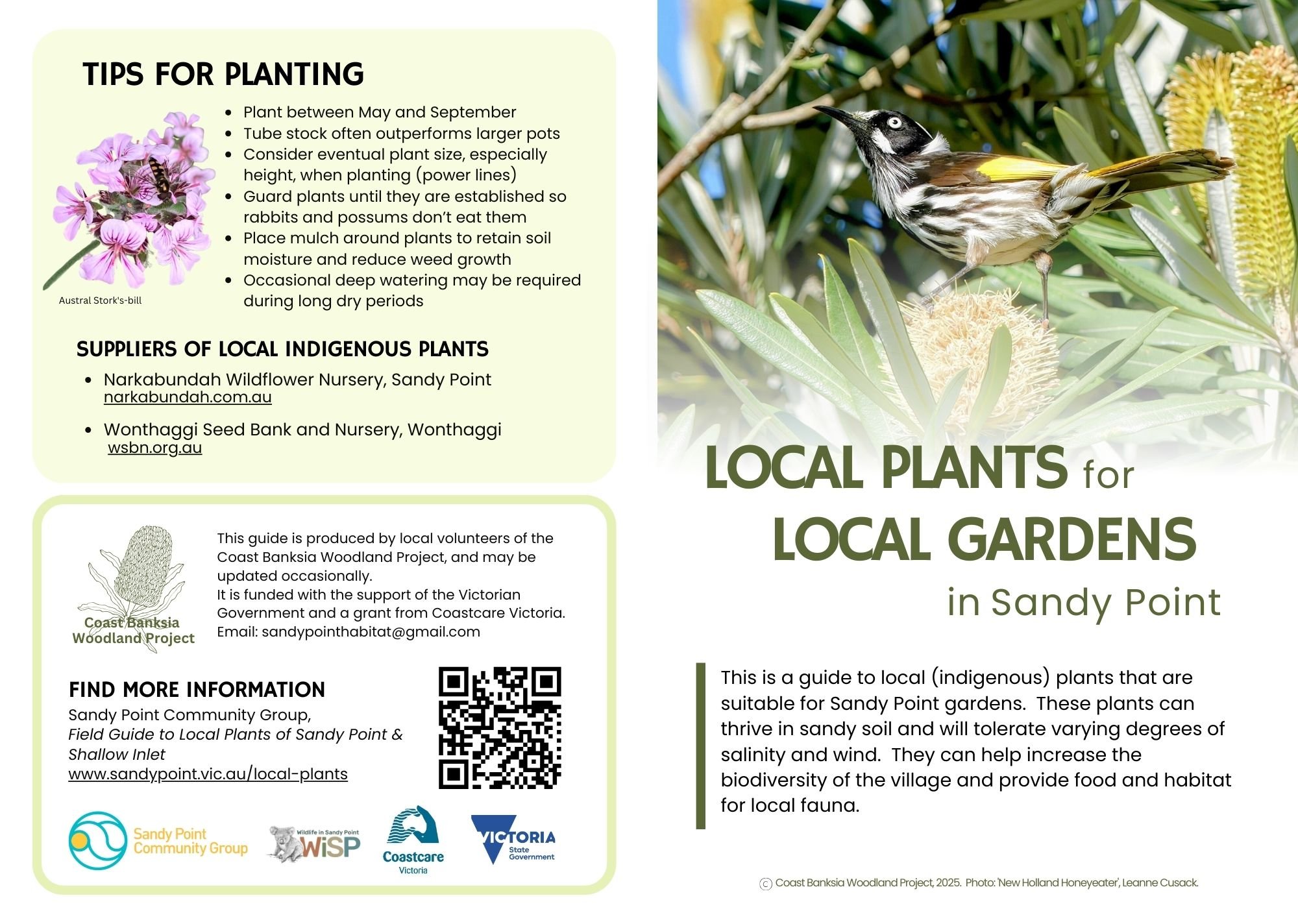
Local Plants for Local Gardens. Side 1

Local Plants for Local Gardens. Side 2
Print bi-fold brochure : ‘Environmental Weeds of Sandy Point & surrounds’

Environmental Weeds of Sandy Point & surrounds. Side 1

Environmental Weeds of Sandy Point & surrounds. Side 2
